5 Data-Backed Writing Hacks to Manage College Workloads (2026 Guide)

The life of a modern student in the United States is often a high-stakes balancing act. Between part-time jobs, internships, and social obligations, the academic “crunch” can feel less like a challenge and more like a mountain. According to recent 2024-2025 education data, approximately 75% of college students report feeling overwhelmed by their academic workload, with writing assignments cited as a primary driver of chronic stress (Crown Counseling, 2024).
When you have three essays due in a single week, the “blank page syndrome” isn’t just a creative block—it’s a mental health hurdle. However, managing a heavy writing schedule doesn’t require superhuman abilities; it requires a strategic shift in how you approach the keyboard.
Here are five data-driven hacks to help you conquer your writing workload while keeping your sanity intact.
1. The “Reverse Engineering” Strategy
Most students start at the beginning (the introduction) and work their way to the end. Paradoxically, this is often the least efficient way to write. Research into cognitive load suggests that the introduction is the hardest part to write because you are trying to frame an argument that hasn’t been fully built yet.
The Hack: Start with your body paragraphs. Build your evidence first, then craft the conclusion. Save the introduction for last. When you already know exactly what you’ve proven, writing the “hook” and thesis becomes an effortless 10-minute task rather than a two-hour struggle.
If you find yourself stuck on how to even begin that opening sentence once you get there, reviewing a list of essay hook examples can provide the spark needed to frame your now-completed arguments effectively.
2. Strategic Outsourcing and Professional Support
There is a common misconception that “doing it all yourself” is the only path to success. However, in the professional world, CEOs and academics regularly use researchers, editors, and consultants to meet deadlines.
In the U.S., the “burnout peak” typically hits during the final year of university, affecting nearly 70% of students (WifiTalents, 2026). Recognizing when your plate is too full is a sign of high emotional intelligence, not a lack of ability. For many students, seeking professional essay writing service is a strategic move to manage specific high-weight assignments while they focus on preparing for exams or attending to personal well-being. This ensures that quality isn’t sacrificed for the sake of a deadline.
3. Implement the “Pomodoro 2.0” Technique
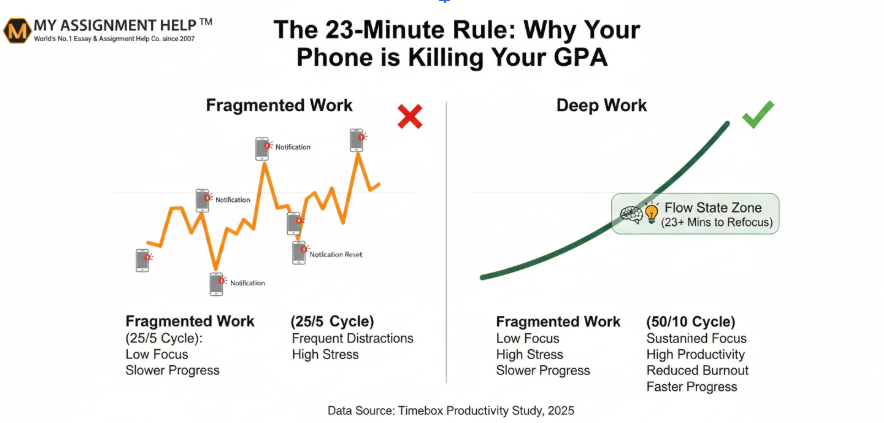
The standard Pomodoro Technique (25 minutes of work, 5 minutes of rest) is famous, but for heavy writing, “Deep Work” blocks are more effective. It takes the human brain an average of 23 minutes to refocus after a distraction. If you stop every 25 minutes, you barely hit your “flow state” before the timer goes off.
The Hack: Switch to a 50/10 cycle.
- 50 Minutes: Intense, distraction-free writing (phone in another room).
- 10 Minutes: A complete physical break—stretch, walk, or grab water. No screens.
Data indicates that students who utilize focused work intervals report a 25% decrease in burnout symptoms compared to those who “marathon” their writing sessions for 5+ hours straight (WifiTalents, 2026).
4. Use the Eisenhower Matrix for Writing Tasks
Not all writing assignments are created equal. A 2,000-word research paper worth 40% of your grade requires a different cognitive energy than a 300-word discussion post worth 2%.
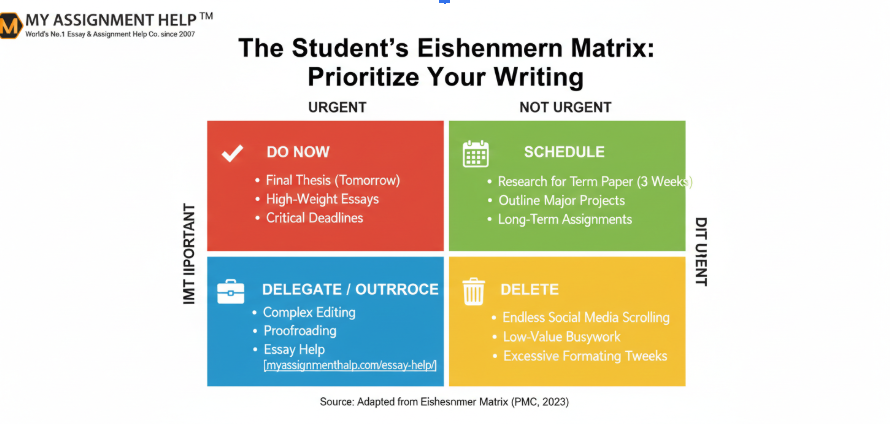
The Hack: Categorize your writing tasks into four quadrants:
- Urgent & Important: High-weight essays due within 48 hours.
- Important, Not Urgent: Term papers due in 3 weeks (do 200 words a day here).
- Urgent, Not Important: Small reflective journals (finish these in one “sprint”).
- Neither: Optional extra credit writing that might be wasting your time.
5. Leverage “Skeleton Outlining”
The “messy middle” of an essay is where most time is lost. You forget your point, go off on a tangent, or realize your third paragraph contradicts your first.
The Hack: Never type a full sentence until your “Skeleton Outline” is done.
- Header: The main claim of the paragraph.
- Bullet Point: The specific evidence/source you will use.
- Bullet Point: The “so what?”—how this connects back to the thesis.
Once this skeleton is built, “writing” the essay is simply a matter of connecting the dots. This reduces the cognitive strain of trying to “think” and “write” simultaneously.
Key Takeaways
- Statistics: 75% of US students feel overwhelmed; 47% report procrastination negatively impacts their GPA.
- The Secret: Start with body paragraphs to avoid the “intro block.”
- Wellness: Use 50-minute deep work blocks to protect your mental health.
- Efficiency: Outsource or seek expert assistance when the workload threatens your health or overall academic standing.
See also: WPS Download Uses in Hong Kong for Business and Education
Frequently Asked Questions (FAQs)
Q: Is it ethical to seek essay help for heavy workloads?
A: Absolutely. Seeking academic support is similar to hiring a tutor. As long as you use the assistance as a learning tool to understand the subject matter and improve your own writing skills, it is a legitimate educational resource.
Q: How do I know if I’m experiencing academic burnout?
A: Common signs include persistent fatigue, irritability, a significant drop in grades, and a lack of motivation for subjects you previously enjoyed. If you feel detached from your student life, it’s time to recalibrate your workload.
Q: How can I improve my writing speed without losing quality?
A: The best way is to separate the “researching” phase from the “writing” phase. Trying to find sources while you are in the middle of a sentence breaks your flow and doubles the time it takes to finish.
About the Author
Samantha Reed is a Senior Academic Consultant at MyAssignmentHelp. With over 10 years of experience in the US higher education sector, she specializes in student productivity and curriculum development. Samantha has helped thousands of students navigate the complexities of university-level writing by implementing sustainable, data-backed study habits.
References
- FasPsych (2025). Student Mental Health Crisis 2025: College Anxiety & Campus Solutions.
- Boston University (2025). 2024-2025 Healthy Minds Study: National Trends in Student Mental Health.
- NIH / PMC (2023-2025). The Illusion of Urgency & The Impact of Mental Health Literacy on Resource Utilization.
- Wexler, N. (2019). Writing and Cognitive Load Theory. ResearchED.
- Research.com (2026). 50 Current Student Stress Statistics: Data, Analysis & Predictions.