AI Agents for Data Analysis: How Intelligent Systems Are Redefining Data-Driven Decision Making
In today’s digital-first economy, organizations are generating data at an unprecedented scale. However, the true value of data lies not in its volume, but in the ability to analyze, interpret, and act on it effectively. This is where AI agents for data analysis are emerging as a game-changing capability. By combining machine learning, automation, and contextual intelligence, these agents enable businesses to extract meaningful insights from complex datasets with speed and precision.
What Are AI Agents for Data Analysis?
AI agents for data analysis are specialized intelligent systems designed to autonomously manage, analyze, and interpret large volumes of structured and unstructured data. Unlike traditional analytics tools that rely heavily on manual inputs and predefined rules, these agents operate as adaptive digital analysts.
They automate data preparation, apply advanced analytical techniques, and continuously learn from historical and real-time data. As a result, organizations can transform raw information into actionable intelligence without depending entirely on human analysts for every step of the process.
Industries such as finance, healthcare, manufacturing, and retail increasingly rely on AI agents to process real-time data streams, uncover hidden patterns, and support faster, evidence-based decision-making.
See also: Guide to Choosing the Perfect Luxury Marble Pooja Room for Your Home
Key Characteristics of AI Data Analysis Agents
Comprehensive Data Management
AI agents are built to handle the full data lifecycle with minimal manual intervention. They automatically collect data from diverse sources such as databases, APIs, IoT devices, and enterprise systems. Through intelligent integration, they unify fragmented data into a single analytical view.
Advanced data cleaning capabilities allow these agents to handle missing values, eliminate duplicates, and correct inconsistencies. They also perform data transformation tasks such as normalization and scaling, ensuring datasets are optimized for accurate analysis.
Advanced Analytical Capabilities
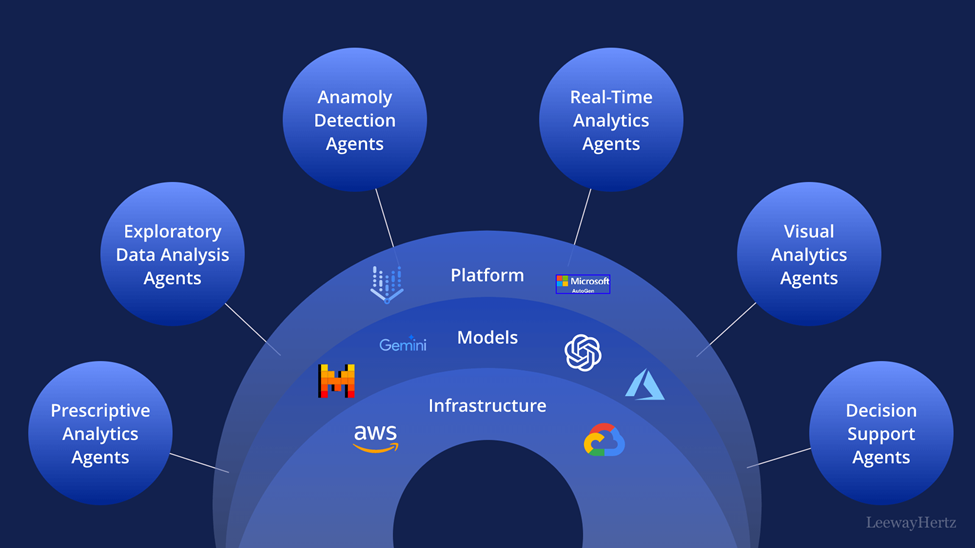
AI agents for data analysis leverage a wide range of analytical techniques, including exploratory data analysis, predictive analytics, and prescriptive analytics. They compute descriptive statistics, generate visual insights, and identify correlations, trends, and anomalies that may be overlooked by traditional methods.
By applying machine learning models, these agents can forecast future outcomes and recommend actions that optimize business performance.
Advanced visualization and reporting
- Dynamic dashboards: Create interactive, real-time visualizations with drill-down capabilities.
- Automated report generation: Produce and update reports automatically, presenting insights in easily digestible formats.
- Custom reporting: Generate tailored reports that condense large volumes of data into visually engaging summaries. Once insights are generated, teams often need to convert them into structured, stakeholder-ready documents such as reports or plans. Tools like ZBrainDocs support this by generating well-structured documents grounded in enterprise data with traceable sources.
Real-Time Insight Generation and NLP Capabilities
One of the defining advantages of AI agents is their ability to deliver insights in real time or near real time. Continuous data monitoring allows organizations to respond quickly to emerging trends, risks, or opportunities.
In addition, Natural Language Processing (NLP) enables AI agents to analyze text-based data such as customer feedback, documents, and reports. Conversational interfaces allow users to query data in plain language and receive clear, human-like explanations of complex insights.
Visualization, Reporting, and Knowledge Sharing
AI agents simplify how insights are communicated across organizations. They generate dynamic dashboards with drill-down capabilities and automatically produce reports tailored to specific stakeholders.
Once insights are generated, teams often need to convert them into structured, stakeholder-ready documents such as reports or plans. Tools like QuantaDocs support this by generating well-structured documents grounded in enterprise data with traceable sources.
This combination of analytics and automated documentation ensures insights are not only discovered but also effectively shared and acted upon.
How Do AI Agents for Data Analysis Work?
AI agents operate through a modular architecture that includes an agent core, planning module, memory systems, and analytical tools. The agent core defines analysis goals and coordinates tasks such as data retrieval, computation, and visualization.
The planning module breaks complex analytical requests into manageable steps, while memory systems—often powered by retrieval-augmented generation—retain contextual knowledge from past analyses. This allows agents to deliver more relevant and consistent insights over time.
By orchestrating tools such as SQL generators, statistical engines, and visualization modules, AI agents execute end-to-end data analysis workflows with minimal human intervention.
Applications of AI Agents for Data Analysis Across Industries
Manufacturing
In manufacturing, AI agents support predictive maintenance by analyzing sensor data to forecast equipment failures. They enhance quality control by detecting defects in real time and optimize supply chains by identifying bottlenecks and inefficiencies.
Legal
Legal teams use AI agents for document review, contract analysis, and compliance monitoring. By analyzing large volumes of legal text, these agents reduce manual effort while improving accuracy and risk detection.
Retail
Retailers leverage AI agents to analyze customer behavior, forecast demand, optimize pricing, and personalize marketing strategies. Sentiment analysis and market basket analysis further enable data-driven merchandising decisions.
Benefits of Using AI Agents for Data Analysis
AI agents significantly enhance accuracy by reducing human error in complex data processing tasks. Their ability to analyze vast datasets at high speed improves operational efficiency and supports real-time decision-making.
From a cost perspective, automation reduces dependency on manual analysis, leading to better resource utilization. Most importantly, AI agents empower organizations to make informed, forward-looking decisions by uncovering insights that drive growth, personalization, and competitive advantage.
The Future of AI-Driven Data Analysis
AI agents are ushering in a new era of intelligent analytics where advanced data analysis is no longer limited to specialized teams. As these systems become more accessible and user-friendly, organizations of all sizes can harness sophisticated analytical capabilities.
The synergy between human expertise and AI-driven intelligence will continue to redefine how businesses understand and use data. To explore how enterprise-grade AI agents for data analysis can be designed and implemented effectively, organizations are increasingly turning to specialized solution providers such as LeewayHertz.
As adoption accelerates, AI agents will play a central role in building resilient, data-driven enterprises equipped to thrive in an increasingly complex digital landscape.